Few consumer experiences have endured quite like opening a pack of trading cards. Since Topps popularized the wax pack in the early 1950s, generations of collectors have chased the same feeling: the anticipation before the reveal and the possibility that something rare might be inside. You bought a pack, tore it open, and decided what to keep, trade, or sell. Then it was over. Save for the few collectors still holding unopened vintage packs, the chance of pulling a 1st Edition Charizard from a physical pack is effectively gone. Digital packs bring that chance back. Platforms rebundle authenticated physical collectibles into randomized online packs that can be opened on demand, with the underlying item either shipped to the buyer or immediately sold back to the platform.
Digital pack opening has reshaped that familiar experience in three ways: (1) the rebundling of iconic inventory has transformed pack opening from an episodic moment into a persistent market, (2) platforms have layered gamification and entertainment around the reveal, and (3) they have stripped away the friction between one pack and the next, allowing a pull to be stored (“vaulted”), shipped, traded, or sold back in seconds, with far greater capital efficiency. What was once an occasional ritual has become an always-on grail hunt.
The shift is already at scale. Rips, launched by real-money gaming company Triumph in October 2025, surpassed six million downloads in roughly eight months and has regularly ranked among the top 10 shopping apps (Wired). That momentum is also visible in the market’s onchain segment, where transactions are recorded on a blockchain and activity is easier to measure. Onchain pack spending reached a record $345M in June before landing at $291M in August, still the second-highest month on record and roughly 4.4x the level a year earlier (Blockworks).
The pack is one piece of a larger shift in how collectibles are discovered and bought. Livestream shopping app Whatnot recorded roughly $8B in GMV in 2025, more than doubling year over year, with sports and trading cards ranking as its bestselling U.S. categories (Whatnot). Pop Mart nearly tripled revenue to $5.4B in 2025, with the breakout success of Labubu blind boxes helping push randomized collecting further into the mainstream (Reuters). The common thread is consumer appetite for surprise, scarcity, and entertainment-led collecting. We believe the lasting opportunity lies not in the reveal itself, but in everything a platform can build around it. At first glance, the product resembles a digital vending machine. At scale, it is becoming something more consequential: a new consumer format at the intersection of collecting, gaming, entertainment, and commerce.
The desire to rip packs is not new. What has changed is the scale of collector demand and the infrastructure surrounding ownership. Record trading activity has expanded the opportunity, while growth in vaulting and digital settlement has made physical collectibles easier to access, exchange, and hold without taking possession.
Demand is creating new ways to collect
Secondary-market trading volume hit an all-time high of $912M in August, more than double the $422M recorded a year earlier (Card Ladder). Meanwhile, PSA, the leading card-grading service, is working through a backlog of nearly 10M cards (PSA). That surge in demand is creating room for new ways to engage with the hobby. Traditional marketplaces are optimized for collectors who know which card they want. Digital pack platforms turn inventory into an on-demand experience built around discovery, anticipation, and the chase. Digital packs do not increase the supply of rare cards. They create more occasions for collectors to hunt for them, ultimately increasing the velocity of capital around the asset class.
Vaulting brings institutional infrastructure to everyday collectors
Separating ownership from possession is not new. High-end art collectors have long used freeports to hold valuable assets tax-efficiently, especially as investments rather than for display. That model is now extending to other types of collectibles. Grading and better price data make cards easier to standardize and exchange digitally, while vaulting allows ownership to change hands without moving the physical asset.
This shift removes much of the friction of physical collecting. Buyers no longer need to receive, store, insure, and reship every card they own, while onchain settlement can add transparency around ownership and transaction history.
The result is less a new collecting behavior than the diffusion of an existing one. Infrastructure once reserved for sophisticated collectors is becoming broadly accessible, making collectibles easier to trade. As participation expands, liquidity can deepen, but so can volatility as activity shifts from long-term collecting toward shorter-term trading.
A market taking shape
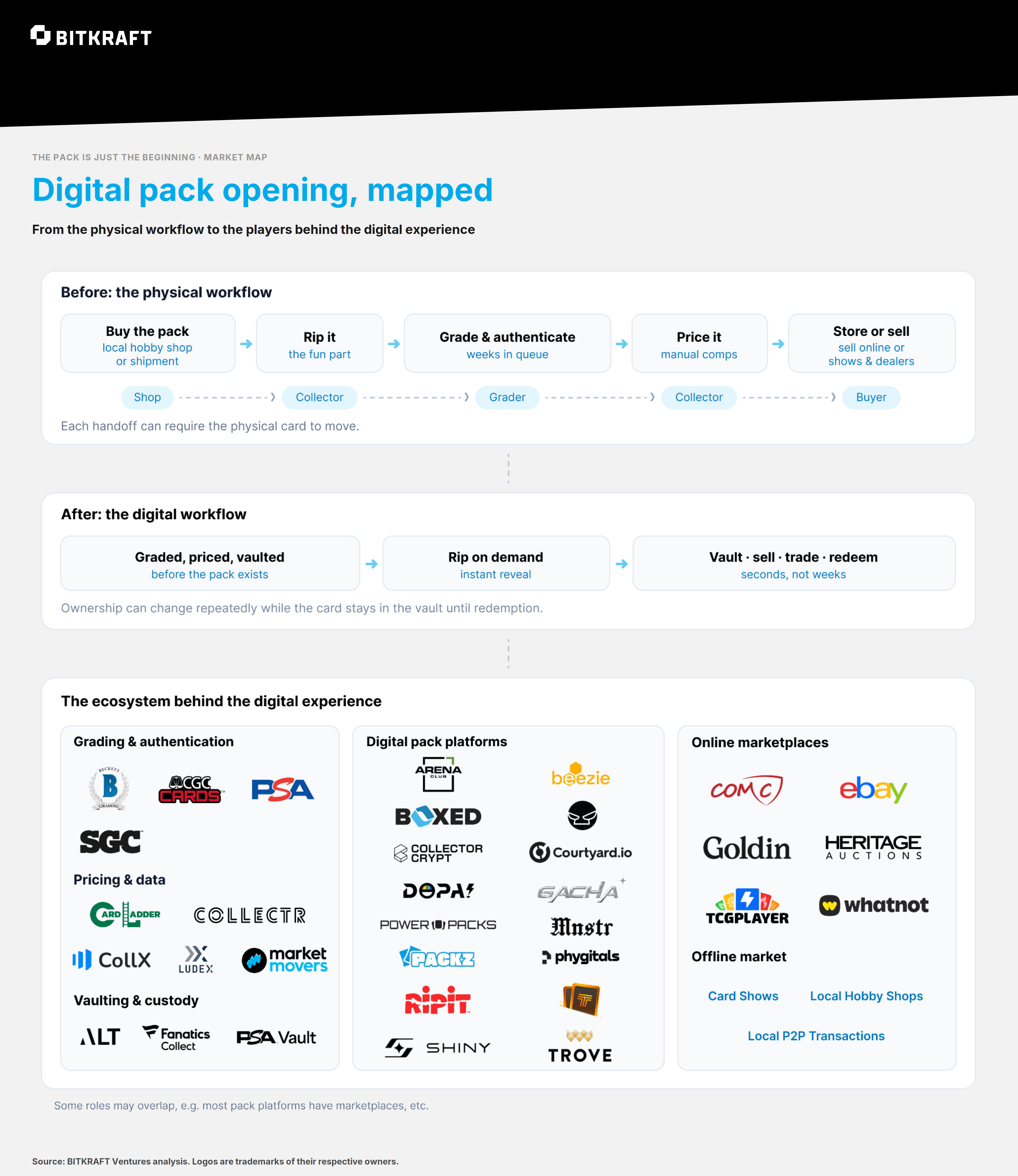
Digital pack opening is quickly evolving into a distinct consumer category. Each product below centers on the same core interaction. Beyond that entry point, the experiences are already diverging. Some remain focused on the reveal, while others extend into marketplaces, collection management, and games. The map captures both direct consumer platforms and the infrastructure increasingly supporting the category.
Courtyard: Expanding the audience for digital packs
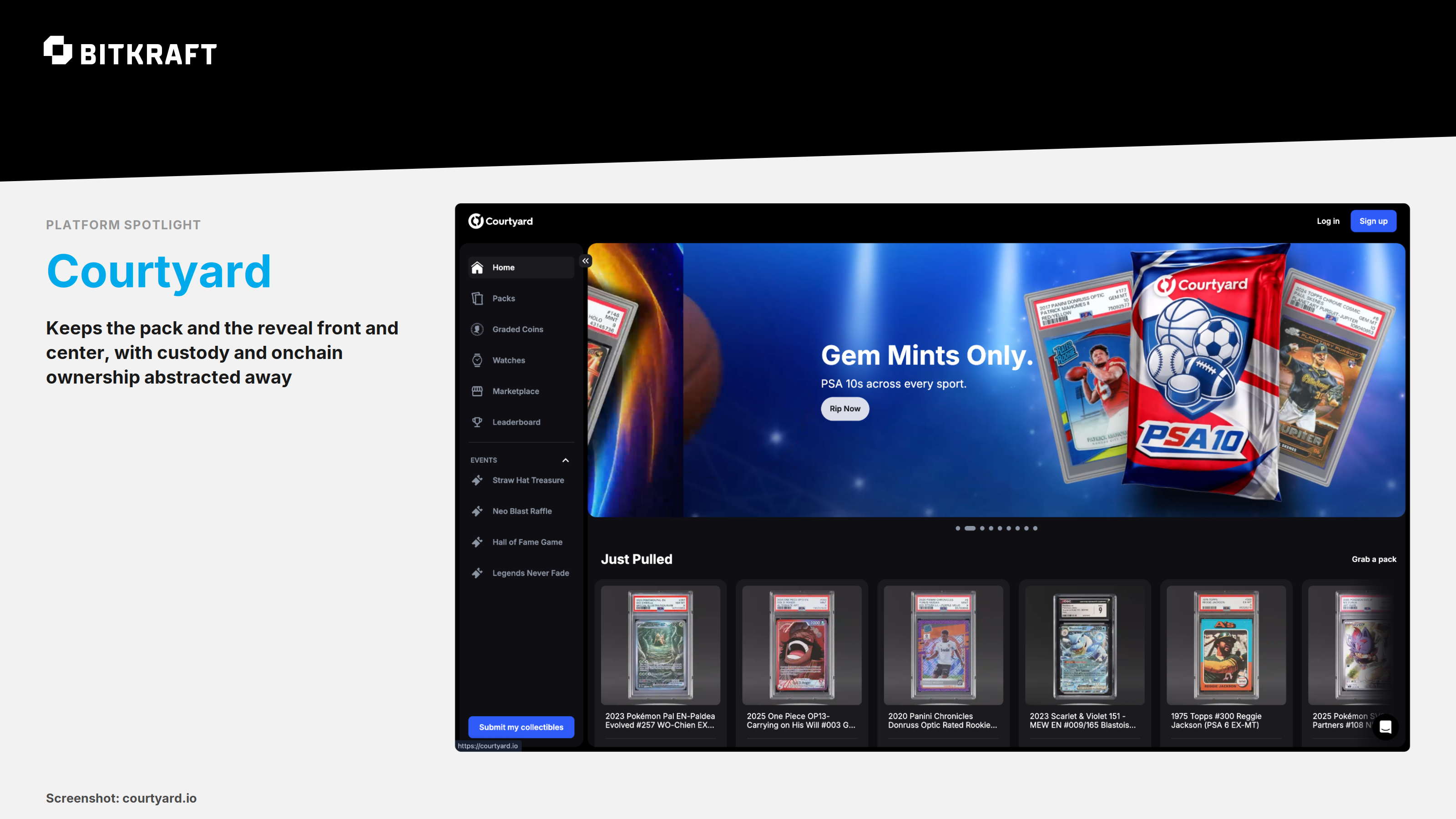
Courtyard was one of the earliest platforms to reach meaningful scale in digital pack opening. Its interface keeps the pack and reveal front and center, abstracting away much of the complexity around custody and onchain ownership. The company also leaned into mobile, launching a native app in July 2025 that made the experience available on the go. Together, its simple consumer experience and mobile traction helped validate a broader playbook for the category: abstract away the crypto rails and deliver the experience through familiar consumer interfaces.
That early lead has translated into rapid growth. Monthly pack spending (net of buybacks) has nearly quadrupled since August 2025, reaching roughly $24M in August 2026 (Blockworks). Courtyard is now extending the model beyond trading cards to comics, coins, and watches, a test of whether the digital pack can be the front door to collecting more broadly.
Collector Crypt: Making distribution portable
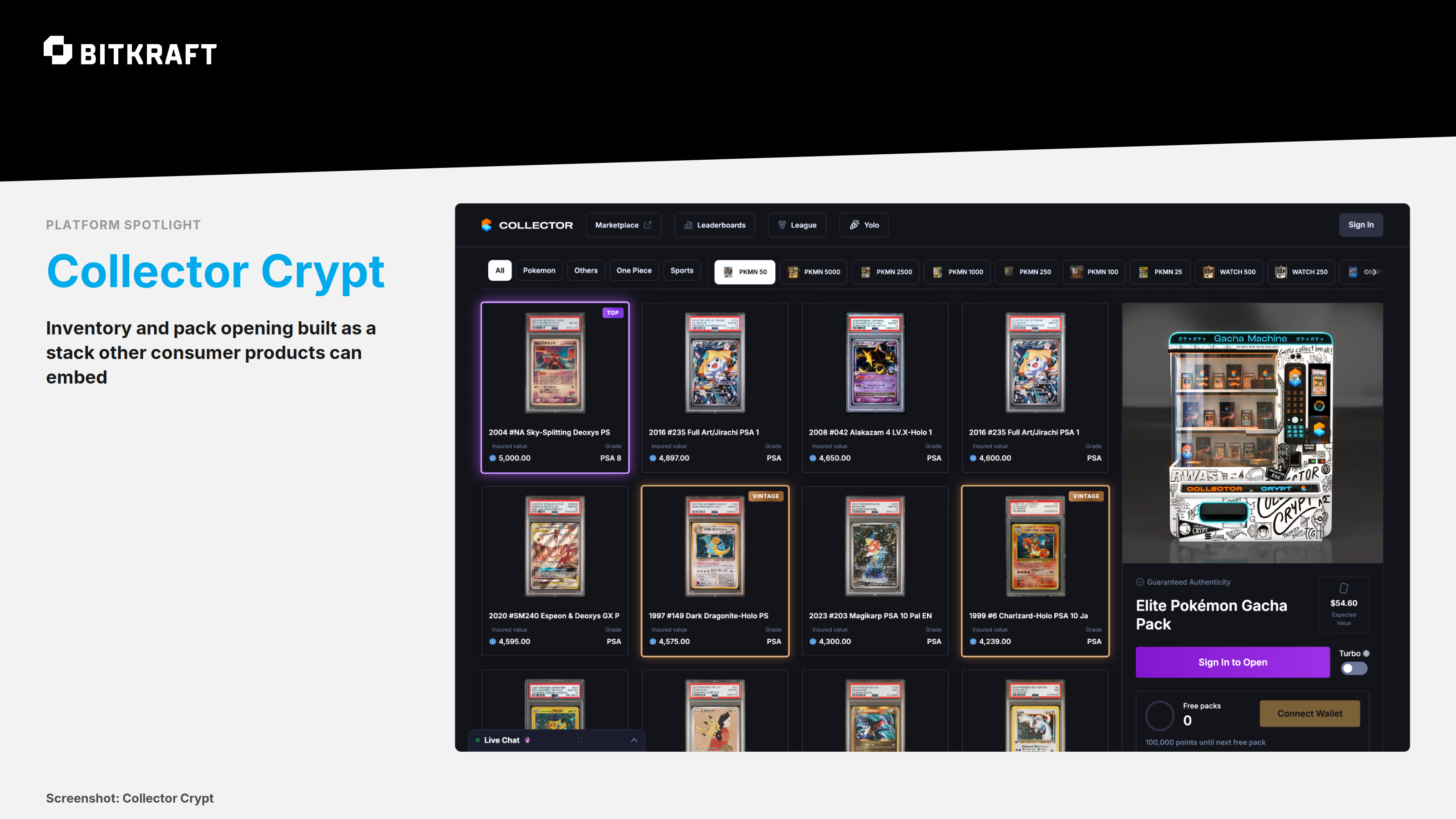
Collector Crypt is the largest consumer platform in onchain pack opening. In August, it generated $141M in gross pack spending, accounting for nearly 50% of the category and marking its sixth consecutive month as the market leader (Blockworks). What makes its strategy especially interesting, however, is the decision to take that product beyond its own interface.
The company has turned its inventory and pack-opening infrastructure into a stack that other consumer products can embed. Solflare, Jupiter, Magic Eden, and Rarible (spanning crypto wallets, trading platforms, and NFT marketplaces) have all launched Collector Crypt-powered experiences. Jupiter, Solana’s largest DEX aggregator, processed more than $10M across 75,000 packs in its first week alone (Dune). That gives Collector Crypt two ways to grow. It can bring collectors to its own platform, or reach them inside products they already use.
More broadly, we expect adjacent consumer platforms to increasingly layer in pack opening and other gacha mechanics as lightweight ways to deepen engagement and monetize existing audiences. Collector Crypt is well positioned to power that expansion.
BOXED: Building the entertainment layer
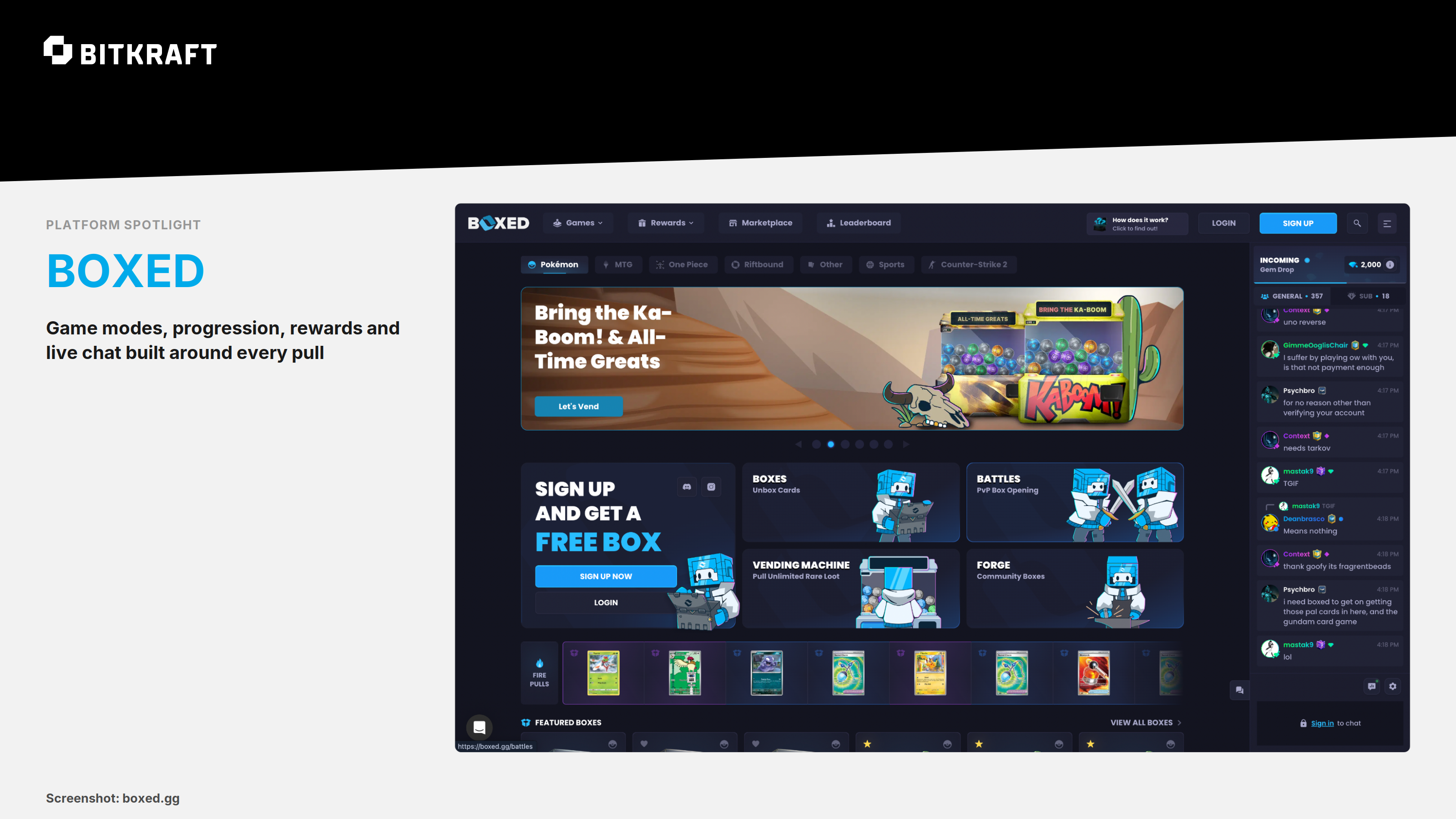
BOXED stands out for treating pack opening less like a transaction and more like a game. We were early investors in BOXED, where our background helped us immediately recognize the team’s vision for a more gamified collecting platform. Multiple collectible categories broaden discovery, while game modes, progression systems, rewards, and sitewide chat give users reasons to return. The pull creates the moment, but progression and community create the habit.
The entertainment layer rests on trust. BOXED publishes exact item-level odds and uses an open-source provably fair system. These features matter because randomized products only become durable consumer experiences if users trust the underlying mechanics. Together, trust and entertainment turn a one-off reveal into a lasting collecting experience.
Incumbents are responding
The incumbent response is already underway. Fanatics launched Instant Rips in March 2025, pairing graded physical inventory with digital reveals in a livestream format. GameStop followed with Power Packs in April 2026, extending the same model through a business that already spans physical retail, graded-card trade-ins, and a broader partnership with PSA. More recently, Topps introduced Instant Packs on Fanatics Collect, allocating part of a new physical print run directly to digital pack opening, while Underdog launched its own pack-opening experience within its existing sports gaming app. These launches suggest the format is finding a place across both collecting and sports entertainment, and we expect more established platforms to follow.
The economics create a strong incentive to participate: a card can be opened, bought back, and repacked several times before redemption, allowing the same inventory to generate repeated transaction activity. Incumbents also arrive with distribution, collector relationships, and in some cases proprietary infrastructure. Fanatics adds licensing and manufacturing power, eBay combines marketplace liquidity with PSA-integrated vaulting, and Whatnot brings creators and entrenched live-commerce behavior.
Startups still have room to shape the category. Early entrants have spent years building audiences, sourcing relationships, product loops, and brands around digital pack opening, while newer startups can experiment more aggressively with instant resale, crypto rails, gamification, and new categories. Incumbents may enter with stronger distribution and infrastructure, but startups retain greater freedom to push the product in new directions while the category is still being defined.
Beyond cards
Cards are the proving ground, but the underlying mechanic is not card-specific. The randomized reveal becomes especially powerful in categories with recognizable grails, wide differences in value, and strong status signaling. We are already seeing the model expand into watches, coins, and comics. Whatnot offers an adjacent signal that entertainment-led commerce can travel well beyond cards: the share of women shoppers more than doubled year over year, while Beauty, Jewelry, and Women’s Fashion grew 791%, 259%, and 223%, respectively (Whatnot). We expect a new wave of startups to apply the model beyond cards, wherever scarcity, surprise, and status can turn shopping or collecting into entertainment.
What will separate the winners
The spotlights above point to a simple conclusion: the reveal itself is a feature, not a moat. As similar interfaces proliferate, competitive advantage will come from everything surrounding the reveal: inventory that earns attention, product depth that brings users back, trusted execution that supports scale, and distribution that expands reach.
These strengths become more powerful when they reinforce one another. Better inventory attracts users, deeper engagement increases retention and LTV, trust opens the door to larger partners, and broader distribution creates more demand and improves the platform’s ability to source what comes next. The winners will build that reinforcing system rather than compete on the reveal alone.
Grails create the stakes and draw the crowd
Inventory does more than determine the value of each pack. A recognizable grail raises the stakes of the opening and gives the platform something to talk about. A single rare card can function like tentpole content, becoming the centerpiece of campaigns, creator openings, and conversations across collector communities. Even users who never open the pack may follow the chase or watch the eventual pull. Exceptional inventory can therefore generate attention far beyond the transaction itself.
The more durable advantage is not securing one headline grail, but building a repeatable sourcing engine. Most collectibles can eventually be found on public markets, so the edge comes from dealer networks, consignment relationships, purchasing scale, and a trusted brand that attracts high-quality inventory directly from collectors. These capabilities can create a flywheel: better inventory draws attention, that attention attracts more sellers, and the resulting supply makes future packs more compelling. The best inventory becomes both product and marketing.
Depth turns excitement into habit
An opening can capture attention without creating a lasting customer relationship. Headline volume can also overstate engagement when the same dollars cycle through repeated openings and buybacks. The stronger signal is retention: whether users find reasons to return beyond the next reveal. Because digital packs sit between gaming and commerce, we look to both for directional retention benchmarks. Social casino offers a useful gaming analogue, where roughly 60% of converted payers make another purchase within 30 days (AppsFlyer), while Whatnot offers an aspirational commerce benchmark at 80%+ month-over-month customer retention (Whatnot). We believe the strongest digital pack platforms are capable of retaining a majority of paying users month over month.
As inventory access and vaulting become more widely available, we expect platforms to compete increasingly on the entertainment built around the assets, borrowing from games through collection quests, progression systems, and recurring events. The strongest implementations will make each session contribute to something lasting: a more complete collection, progress toward a goal, or stronger relationships with other collectors. The experience needs to remain fun even when the pull disappoints. Our portfolio company Kolex illustrates how gameplay can give collections an ongoing purpose. Collectors scan physical cards to unlock digital twins, which they can use in both fantasy contests based on real-world player performance and simulated matches. For pack-opening platforms, building gameplay around the assets could help turn a moment of excitement into a lasting habit.
Trust and execution earn the right to scale
Randomness magnifies every weakness in a product. Collectors need to understand their true odds of pulling specific items and whether every outcome maps to real inventory. Product integrity ultimately determines whether an entertaining reveal feels fair or becomes a source of suspicion.
The mechanics that make these products engaging can also attract regulatory scrutiny, especially as randomized outcomes become easier to convert into cash. Challenges to loot boxes and restrictions on sweepstakes casinos show that this scrutiny is already underway. We view that risk as real, but meaningfully shaped by product design and the markets a platform serves. Physical collectibles give the experience a tangible foundation, but do not by themselves resolve its legal treatment. IP holders may also push back if a platform’s mechanics or marketing create reputational concerns for their franchises. Transparent odds, clear pricing, consumer safeguards, and carefully structured buybacks remain important to building responsibly, alongside a sound legal basis for operating. We believe the opportunity remains compelling, but platforms will need to preserve the confidence of collectors, brands, and commercial partners as they grow.
Trust must also extend beyond the interface. Valuable collectibles need to be authenticated, securely stored, and reliably delivered. A lost package or delayed redemption can quickly undermine that trust, making fulfillment a core part of the experience. Payment providers, creators, brands, wallets, and retailers will only distribute the product if they trust both its compliance and its physical execution. A platform may acquire users through excitement, but it earns the right to scale through reliable execution behind the experience.
Creators can compound the platform
The strongest platforms can move beyond creating every experience themselves. BOXED’s Forge lets users create their own boxes from existing inventory, choosing the theme, contents, odds, and the commission they earn when others open them. User-created boxes already represent a meaningful share of platform activity, showing how curation itself can become a meaningful form of UGC.
The strategic advantage is broader than content creation. Giving collectors and creators tools to build from existing inventory can expand the number and variety of experiences without scaling the internal curation team at the same rate. Collectors bring taste and niche expertise, while influencers bring an existing audience, making them both curators and distribution channels.
Distribution determines how far the product travels
Embedded products can reach users through platforms that already command attention. That access can lower acquisition costs and accelerate adoption, but the tradeoff is who owns the customer: the distributor may retain the relationship while the provider risks becoming an interchangeable supplier. Standalone destinations preserve control over the brand, data, and economics, but must build their audiences directly.
The strongest models may combine both approaches. A flagship destination can establish the product, brand, and collector relationship, while a portable version extends the same inventory and experience into new channels. Distribution becomes especially powerful when each additional surface brings incremental demand without fragmenting inventory, weakening trust, or degrading the experience. The goal is not simply to appear in more places, but to make every new channel strengthen the underlying platform.
After the reveal
Digital pack opening does not need to replace card shows, hobby shops, or traditional marketplaces to become a meaningful category. It expands the number of occasions on which collecting can happen. The familiar reveal now comes with on-demand access, digital custody, and instant liquidity. As the format moves into new collectible categories and reaches users through more consumer surfaces, the opportunity expands with it.
We believe the strongest platforms will use the pack as an entry point into a broader, persistent collecting experience. The next wave of startups will not simply recreate what already works, but build on proven behavior to create entirely new experiences. The category will ultimately be defined by the platforms that turn that behavior into something durable.
The pack opens in seconds, but the opportunity lies in everything that happens after the reveal.
Disclaimer:
The views expressed herein are those of the author as of the date of publication and are provided for informational purposes only. Nothing contained herein should be construed as investment advice, a recommendation to buy or sell any security, or an offer to provide investment advisory services. Certain statements reflect opinions, expectations, assumptions, and forward-looking views regarding industries, markets, technologies, and business trends, which are subject to change and may not prove accurate. Industry statistics, market data, and company information are derived from publicly available sources, including company disclosures and third-party research providers believed to be reliable, but have not been independently verified and no representation is made as to their accuracy or completeness. BITKRAFT Ventures or its affiliated funds have invested in certain companies discussed herein, including BOXED and Kolex, and therefore have financial interests in those companies. References to companies, products, technologies, or market participants are provided solely for illustrative purposes and should not be construed as an endorsement or investment recommendation. Past outcomes and historical examples referenced herein are not indicative of future results.