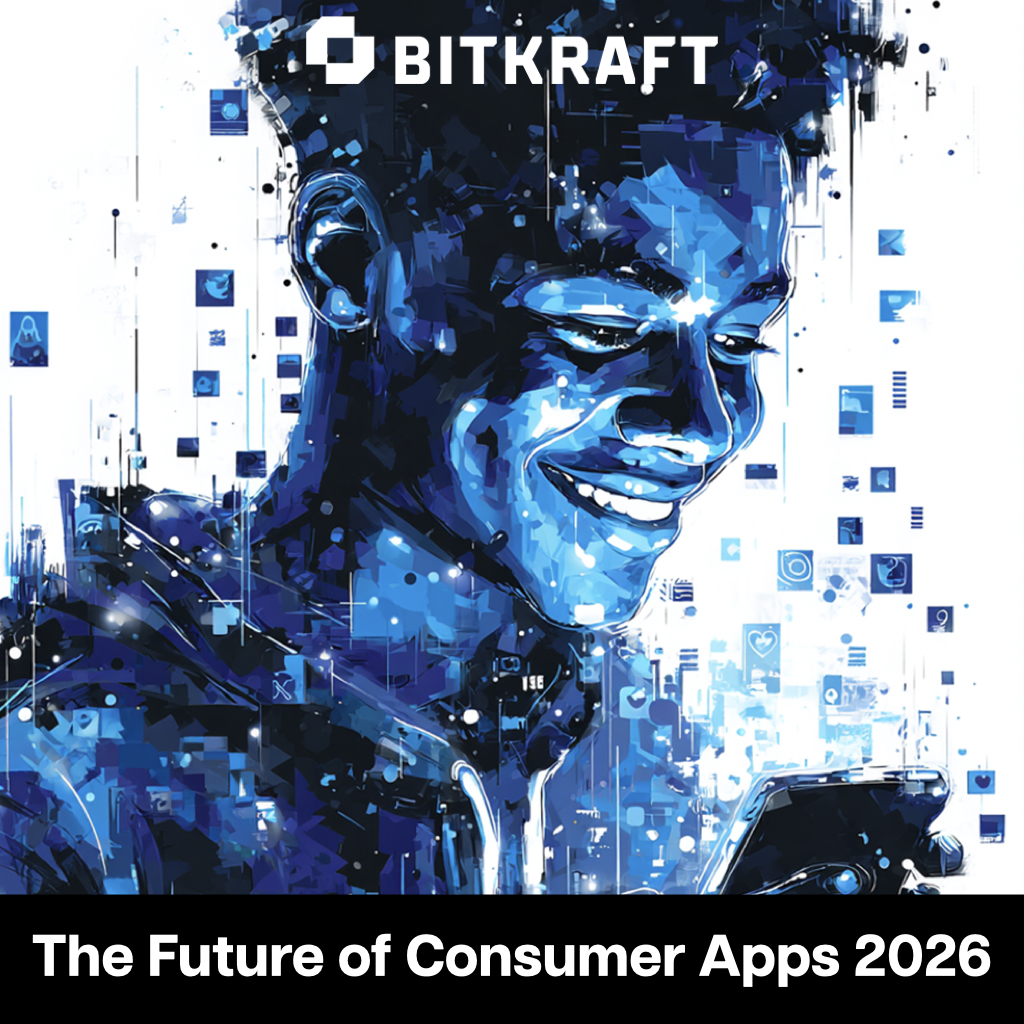
The Future of Consumer Apps: How AI + Game-Design Principles Are Reshaping Every Category
BITKRAFT Report | March 2026
In 2025, a quiet inflection point reshaped the consumer app landscape: for the first time, non-gaming apps surpassed gaming in app store revenue. Not because gaming declined, but because the design principles that made gaming a $200B+ industry have begun migrating into every consumer category.
Streaks, progression systems, adaptive difficulty, variable rewards – the engagement architecture that kept billions of players returning to their favorite games is now being embedded into how people learn, invest, shop, and manage their health. Simultaneously, AI has collapsed the cost of delivering these experiences at scale, making personalization, dynamic content, and adaptive UX accessible to seed-stage teams operating on startup budgets.
The convergence of these two forces is producing a new class of consumer product: AI Apps 2.0. Whereas the 1.0 wave consisted mainly of basic companions, chat apps, generative media and initial productivity apps, these are applications that learn, adapt, and reward in real time, building compounding engagement loops by deepening their understanding of their users with every interaction. This is their moat. The best of them don't feel gamified at all. They simply feel like the most intuitive and satisfying-to-use version of the product that could exist.
We believe the category-defining companies of this cycle will be built now. The behavioral shift has already occurred. The infrastructure costs are falling and consumer-end computing power is growing. What remains is execution, and knowing where to aim.
This report is our map.
Drawing on eight years and 150+ investments across games, platforms, enabling technologies, and consumer applications, we examined how game-design mechanics and AI capabilities are converging across sectors. Our goal: to identify where the next wave of consumer breakouts will emerge, and what separates durable from commoditized.
Inside the report:
The consumer behavior shifts creating outsized demand, including why over 40% of the global population now carries gaming-conditioned expectations into every app they use, and implications for product design.
A framework for building durable moats in an era where content is no longer a differentiator, covering proprietary data strategy, the role of "magical moments" in early retention, and why localization is now a competitive weapon rather than a feature checkbox.
Sector-by-sector analysis across six categories (Education, FinTech, Ecommerce, Health & Wellness, Social & Community, and emerging verticals) with market sizing, incumbent vulnerabilities, the specific game mechanics and AI capabilities driving each opportunity, and case studies from companies demonstrating early proof points.
The infrastructure stack enabling this new wave, from AI-powered user acquisition and content creation to gaming-grade LiveOps, dynamic monetization, and programmable digital assets.
The investment case for consumer tech, where ~20% of unicorns are consumer companies yet less than 10% of venture capital flows to the category. Gamified consumer apps have driven $20.7B in private market transactions since 2020 across 208 deals, but nearly all activity concentrates in just three verticals. The whitespace is substantial, and the global gamification market is projected to grow from $29B to $112B by 2031.
Our predictions for where this market is headed, including how we expect vertical diversification and company formation to evolve over the next five years.
At BITKRAFT, we believe gaming is not just the largest entertainment sector, it is the foundational design language for the next generation of consumer experiences. This report reflects our conviction that the founders who combine game-design intuition with AI-native infrastructure will build the most consequential consumer companies of this decade.